| WC Father paired with CB mother, 2001
June, 2001:
Female molted to approx. 4 1/2" legspan
July 7th, 2001:
Male's maturing molt.
He too is approx.
4 1/2"
Jul 26th, 2001: Introduced CB mother+WC father
26 July- 28 Aug, 2001: Couple cohabiting
Aug 28th, 2001:
Eggsac created 33 days after introduction; male removed
Oct 8th, 2001:
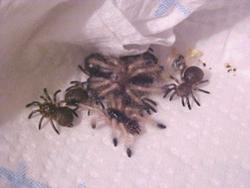
Fully developed spiderlings emerged.
97 spiderlings mobile and feeding 40 days after eggsac creation
GO-01-A
Notes on this breeding:
This seemed to be a fairly large brood, given other people's accounts
of their success with this species. Also, the quick development time
of the offspring in relation to other accounts may be due to temperature
ranging from 85-89 degrees F in the vivarium.
As an interesting aside, the mother created the eggsac with the male
still in the vivarium. |
WC Father (a) paired with WC Mother (a), 2002
Oct 20th, 2002:
Couple introduced
Oct 20th- 20 Nov, 2002:
Couple cohabiting
Nov 20th, 2002:
Male removed
Nov 24th, 2002:
Eggsac created 36 days after introduction
Jan 8th, 2003:
Nymphs begin molting into setae-having spiderlings
45 days after eggsac creation.
Jan 9th, 2003:
All spiderlings molted.
50 in total 46 days after eggsac production.
GO-03-B
Temps were approx. 75-85 degrees F, and humidity at approx 80%
|
WC Father (b) paired with WC Mother (b), 2002
Oct 20th, 2002:
Couple introduced
Oct 20th- 20 Nov, 2002:
Couple cohabiting
Nov 20th, 2002:
Male removed
Nov 27th, 2002:
Eggsac created 39 days after introduction
Jan 5th, 2003:
Nymphs all molted into setae-having spiderlings
39 days after eggsac creation.
29 Spiderlings total.
GO-03-A
Notes on this breeding:
This female was equal in size to the female that produced GO-03-B.
Likewise, the males and the females of both pairs were originally captured
in the same reptile shed in Guyana.
While in captivity, they were fed crickets from the same source and
kept at the same temps, living inches from one another. The only
difference is this one had a slightly larger enclosure, but I doubt accomodations
were a factor.
Also, note the shorter incubation period.
Why the much smaller number of spiderlings?
Weakness of male's sperm?
|
WC males (c) and (d) paired with CB female, 2002-3
March, 2001:
Female "born"
Nov 18th, 2002:
Couple (WC male c) introduced
Nov 18th- Dec 13th, 2002:
Couple cohabiting
Dec 13th, 2002:
Male (c) removed
2 Feb, 2003:
Female Molted :(
Apparently, she was too far along in her molt cycle to breed.
28 May, 2003:
Another wild-caught male (d) introduced.
Couple mated readily and are cohabiting.
Temps range from 76 to 88 degrees F.
12 June, 2003:
Male consumed (not killed, but CONSUMED).
Notes:
This female was paired with several other males during various points
in her molt cycle since 2003.
None resulted in offspring.
The female had pasted fecal matter on her anus and spinnerets in December
of 2004. She died in February of 2005. It is assumed that she had
some sort of internal dysfunction that affected her ability to lay eggs.
|