
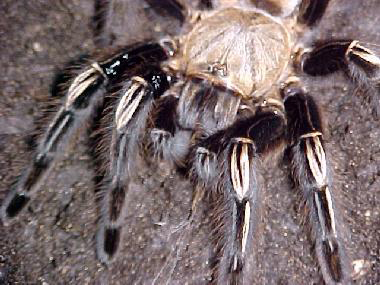
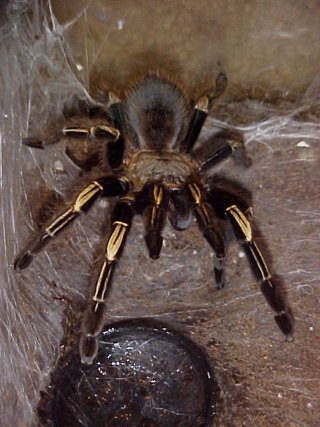
 Note the coloration differences between this spider and the one on the right. Neither photos are altered, nor were they taken under different conditions. The specimen above is a wild-caught individual imported from Guyana in 2006. The flash did emphasize the interior stripe on the tibia; in real life, it is only faintly visible. The spider on the right was captive-bred in 1997, and typical of most E. murinus in the hobby then. |
Skeleton Tarantula
Ephebopus murinus These are the duckbill platypus of tarantulas! They have forelegs that are flattened at the ends like an arboreal species, yet they prefer to burrow. They possess the velvety and smallish rear-ends of baboon spiders, yet are indigenous to the Americas. The wildest feature is that they do have urticating hairs, but they're on the pedipalps! The leg striping is similar to a Costa Rican Zebra's (Aphonopelma seemani), but more yellowish. Their legs are black, they have small brown abdomens, and the carapace is coffee colored or golden. Like most genera in the subfamily Aviculariinae (except the genus Avicularia, ironically), their forelegs are much larger than their hind legs. |
 |
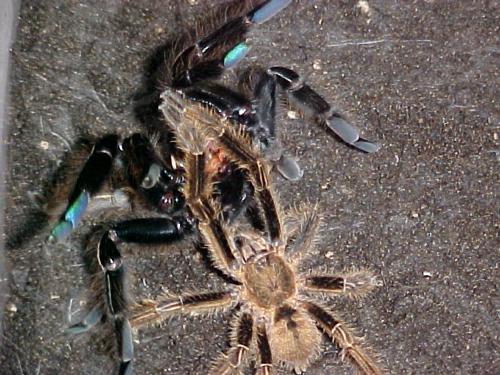
The leggy mature males of Ephebopus murinus are very easy to distinguish from the females.
Ideal
Setup: A 2-5 gallon container with enough peat/potting soil
for digging in (fill it at least 4-5 inches deep). Supply a water dish
and lightly moisten the substrate once or twice a week or so to keep a
good amount of humidity. Keep the temperature around 75-85 degrees F if
possible.
Food:
Any bugs that haven't been exposed to pesticides (equivalent
of 3-5 crickets a week for adults). My captive-bred girl is
voracious and will often walk around with 4 crickets in its fangs at
one time.
Eight
Home | Site
Map | Caresheets