
 Click here for interesting info on breeding this species |
Pinktoe Tarantula
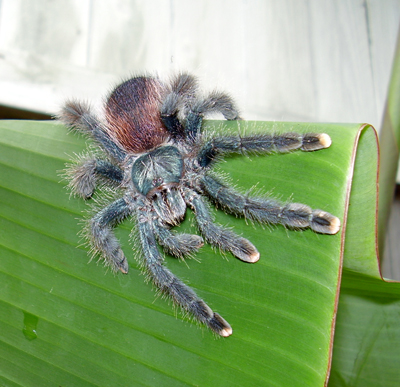
Avicularia avicularia Avicularia means "bird eater" in Latin. When Karl Von Linne (also known as Linnaeus) attempted to catalog virtually every known animal on the face of the Earth (including humans), the Theraphosid his list. In 1758 (the time of Linne's publication), they were generally all called "bird spiders" or "bird eaters;" in fact, Avicularia avicularia was the binomial given for anything resembling what we now call a "tarantula". "Bird eater" has stuck as well, though birds certainly do not make up a significant part of a tarantula's diet. As adults, they are fairly dark overall with pink "toes;" they have greenish highlights on the carapace, reddish setae on the opisthosoma and rear legs, and a bluish tinge to the femur. The caput is not prominent, and the fovea is fairly straight. As "newborns", the carapace is black, the legs are pink with black tips, and the abdomen is a striped pattern of black and red. Mature males are generally of darker coloration than females. . |
Range: A. avicularia
are a widespread species that range all over northern South America.
Since Guyana is a common collection locale, they are often dubbed with
the common name "Guyana Pinktoe".
Habitat: Trees,
low plants, under eaves, behind the tanks of toilets
in gas stations, etc. They are very adaptable and are one of the
few species of tarantula that coexist with mankind's expansion.
Size: Fully grown,
they're about 4 1/2 inches in legspan.
Attitude: Slow
moving for an arboreal, but fast compared to most terrestrial species with urticating bristles.
They're unlikely to bite and they can't "flick" their urticating bristles-
they have to press them into an assailant. While some individuals
of this species may act relaxed, most are quite skittish when held.
Also, they are sometimes prone to using their feces as a defense mechanism-
and they can be quite accurate with it!
Some people attempt to keep
this species in a communal enclosure and, while they may tolerate each
other longer than other members of Avicularia, the experimenters
are often disappointed with the disastrous results. I've seen a large
communal enclosure with over 30 spiders in which an unestablished female
intentionally got into a confrontation with another female with an established
web. There was no biting, but fangs were bared and slapping with
the forelegs took place. I have heard of A. avicularia not
only eating each other in such arrangements, but simply killing their cagemates
without consuming them- that strongly suggests to me that they do not desire
to live together. In the wild, they appear to live like common North
American house spiders- close together if there's a good food source, but
there's room to leave if necessary. They express no need to be in close
proximity to one another. In fact, I have heard of NO tarantula species that
is "communal" by strict definition- only of ones that will cohabit and some that will exhbit some mothering behaviors for their young.
However, breeding is often done by allowing the male to cohabit with the
female for some time.
Dwelling: As
these tarantulas are tree-dwellers, they prefer climbing space to floor
room.
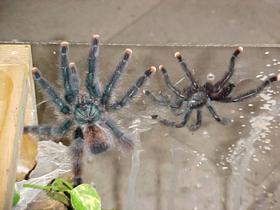
Note the coloration and size difference of the male on the right. Also note the feces sprayed on the wall of the enclosure. A. avicularia is fond of such things. . . . Info in breeding this species is located here. |
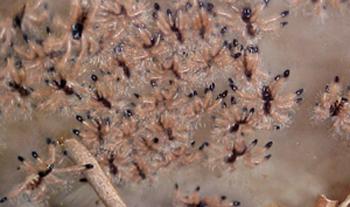
Baby Avics. . .oodles of 'em fresh out of the sac. Click here for info on their breeding. |

Avicularia species are quite adept at perching on smooth surfaces while enjoying a meal, merely resting, or doing other things, as demonstrated by this couple mating on a vertical wall. |
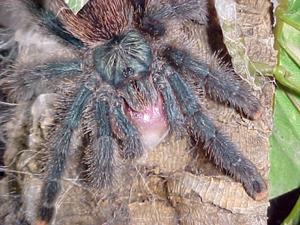
Yes, they will consume vertebrates. Note how the digestive fluid of this A. avic is dissolving the fuzz off of this "fuzzy" mouse. |
Ideal Setup: A
container
of approximately 2 1/2 to 5 gallons for arboreals that can be accessed
from its side. There should be climbing materials (cork bark, etc.) and
a thin layer of substrate at the bottom to retain moisture.
Supply
a water dish and lightly moisten the substrate in the enclosure twice a
week or so to keep a good amount of humidity (perhaps above 60%. . .but
keep an eye out for fungus growths and mites). You can also lightly
mist
their web retreats occasionally. Keep the temperature around
75-85
degrees F if possible. As they are native to wet regions, some
people
make the mistake of giving them stuffy, soaking accomodations.
That
is not necessary, as they live ABOVE the moist earth in nature, where
there
is no humidity retaining enclosure. Conditions that are too
damp will lead to fungus growths and make the spider ill or kill
it.
Fatality is particularly common with spiderlings of this species,
and common causes are a lack of ventilation coupled with high
humidity, or overventilating and dessication.
Food: Any active
bugs (such as Blatta lateralis) that haven't been exposed to pesticides (2-4 adult cricket-sized per week).
They will also consume small frogs, young anole lizards, and baby mice
deftly placed in their web.
Eight
Home | Site
Map | Caresheets